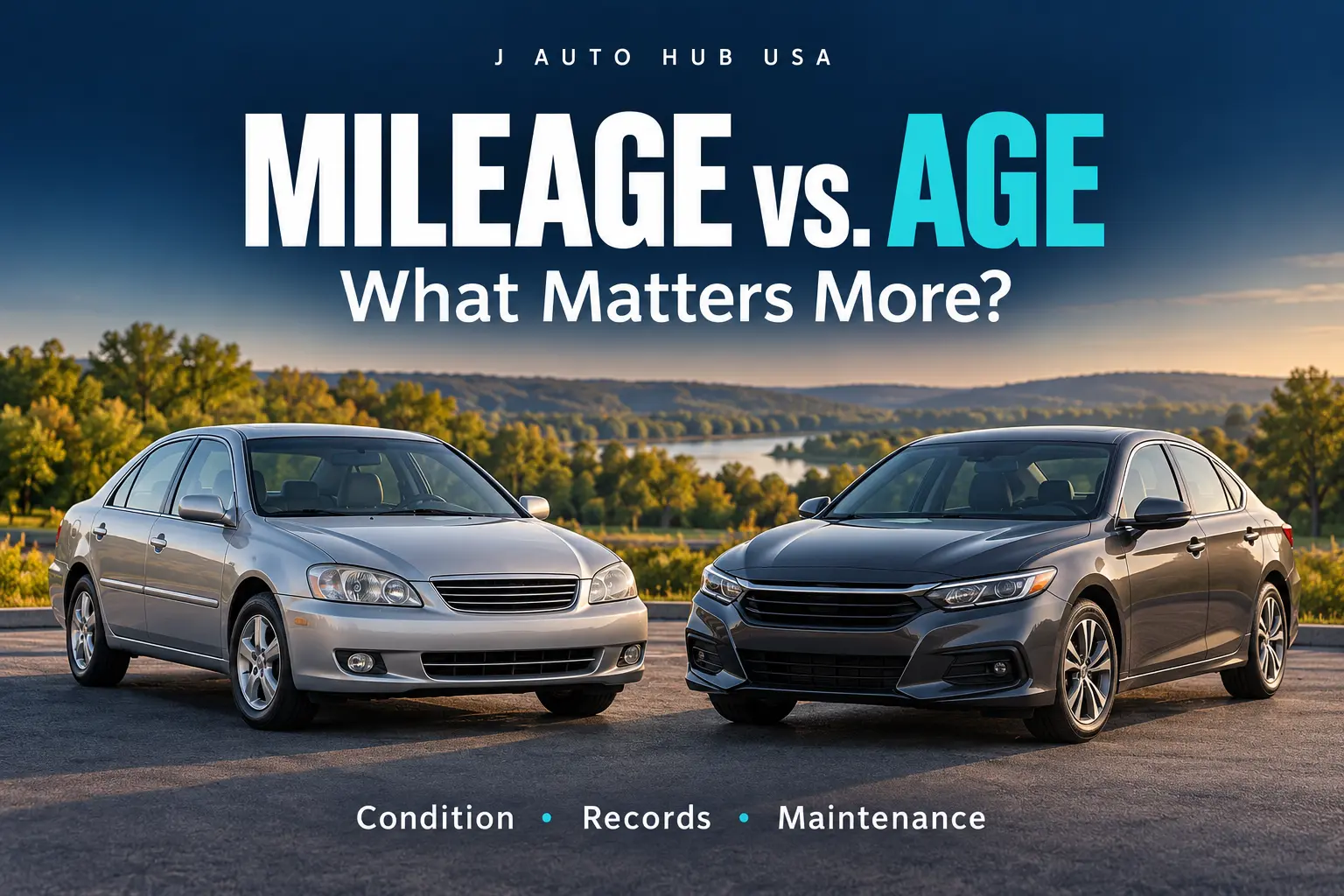
An older car with fewer miles or a newer car with more miles: which deserves a place on your shortlist?
For used-car shoppers in Springfield, MO, that decision should start with how the two vehicles have been maintained, what condition they are in, and what you expect from your next car.
What Does Mileage Tell You—and What Does It Leave Out?
Mileage records distance traveled. It does not tell you everything about the journeys, maintenance or repairs behind that distance.
Treat the reading as a starting point for questions:
- Do dated service records show a consistent mileage progression?
- Which scheduled services have been completed?
- What work is due next for this exact model and engine?
- Is the explanation of the vehicle’s previous use supported by records?
NHTSA recommends comparing the odometer with the title and maintenance or inspection records. It also advises looking for wear that seems inconsistent with the displayed mileage. An unexplained mismatch deserves investigation before you proceed. (NHTSA)
Dividing total miles by years in use can provide context. For example, 90,000 miles over six years equals approximately 15,000 miles per year. That calculation does not reveal whether the car was driven mainly on highways, maintained properly or left unused for long periods.
Why Does Age Matter on a Low-Mileage Car?
Low mileage does not stop time-related deterioration. Tires provide a clear example: their materials can degrade even when they have seen limited use.
Michelin recommends annual professional inspections after five years of tire service and precautionary replacement ten years after manufacture, regardless of remaining tread. Vehicle-manufacturer recommendations also matter. These are tire guidelines, not a ten-year retirement rule for the whole car. (Michelin USA)
When considering an older vehicle, ask about its storage history, maintenance dates and the age of replacement parts. Have a mechanic assess its present condition rather than assuming limited use preserved everything.
Also check the actual equipment. If a backup camera, driver-assistance feature or phone connection is important to you, verify that it is fitted and works on the specific vehicle. A model year alone is not enough to confirm the features you need.
Is a Newer High-Mileage Car Better Than an Older Low-Mileage Car?
Either could be the stronger choice. Use the age-and-mileage combination to decide what to investigate next.
| Vehicle profile | Questions to resolve |
|---|---|
| Newer, higher mileage | Are the miles consistent with its records? Which services have been completed, and what comes next? |
| Older, lower mileage | Was it used regularly or stored? Have time-based maintenance and tire condition received attention? |
| Older, higher mileage | What does the inspection show, and does the price leave room for identified work? |
| Newer, lower mileage | Does the history support the reading, and does the vehicle justify its price compared with alternatives? |
No row is an automatic approval or rejection.
A useful shortlist contains vehicles whose condition and costs you can explain. “Newer” and “low mileage” are useful filters, but neither should end the comparison.
You can start by comparing model years, mileage and asking prices in J Auto Hub USA’s used-vehicle inventory.
Are Highway Miles Always Better Than City Miles?
Do not assume a high-mileage vehicle accumulated easy highway miles. The odometer cannot prove how it was used.
Driving conditions can affect maintenance requirements. For example, Ford’s 2023 Bronco Sport manual identifies extensive idling, certain low-speed commercial use, towing and repeated short trips as conditions that can require additional maintenance. The correct schedule depends on the vehicle and its use. (Ford owner’s manual)
Ask about previous driving patterns, then check available records. If that information is missing, treat it as unknown.
“Mostly highway miles” should prompt a follow-up question, not replace an inspection.
What Should You Compare Before Choosing?
1. Match the Records to the Exact Vehicle
Check that the vehicle identification number, or VIN, matches across the car and the documents you review.
Read service entries by date, mileage and work performed. A folder containing several receipts may still leave important gaps. Ask a mechanic to compare the records with the manufacturer’s maintenance schedule for that model and engine.
Missing records do not prove neglect. They mean you have less evidence to rely on.
2. Get a View of Its Current Condition
A history report and a mechanical inspection answer different questions. The FTC explains that a history report does not replace an independent inspection and typically does not reveal mechanical problems.
Ask an independent mechanic for a written assessment and estimates for necessary repairs. A safety inspection also has a different purpose from a broader mechanical evaluation. (FTC Consumer Advice)
For this comparison, ask the mechanic:
- What needs attention immediately?
- What maintenance is due soon?
- Which findings would make you advise against buying?
- Are there unresolved issues requiring further diagnosis?
3. Check Open Safety Recalls Separately
Use the VIN in NHTSA’s recall lookup. Follow up with the manufacturer or an authorized dealer about any applicable recall.
A result showing no unrepaired recalls is not a mechanical condition report. NHTSA also identifies search limitations, including some newly announced recalls and most recalls older than 15 years. (NHTSA)
4. Include the Work You Would Inherit
Compare the purchase price alongside written estimates for identified repairs and scheduled maintenance. Keep those costs separate from routine ownership expenses such as fuel and insurance.
Ask about the same items on both vehicles. Otherwise, you may compare one car with its maintenance needs disclosed against another whose needs have not been investigated.
A Practical Example: Two Cars, Different Trade-Offs
Imagine two comparable gasoline sedans. These are hypothetical vehicles, not current J Auto Hub USA listings.
| Detail | Car A | Car B |
|---|---|---|
| Age | 10 years | 6 years |
| Mileage | 60,000 miles | 105,000 miles |
| Service evidence | Several gaps | Records showing scheduled work |
| Inspection findings | Tire replacement and overdue service identified | No immediate repairs identified; future scheduled service noted |
| Initial appeal | Lower mileage | Newer model year |
Car B deserves a closer look despite its higher mileage. Its records and inspection provide more information about what you are buying. That does not establish that it will last longer.
Car A could still be worth considering if the missing information is resolved and its price accounts for the work needed. A large price difference may change the comparison; an unresolved serious defect may end it.
Now add your own driving. If you expect to drive 12,000 miles per year for three years, you would add 36,000 miles:
- Car A would reach approximately 96,000 miles.
- Car B would reach approximately 141,000 miles.
Use those projected mileages to check the maintenance each car would reach during your ownership. This is a planning calculation, not a prediction of remaining vehicle life.
How Should Your Driving Routine Affect the Choice?
For a daily commute around Springfield, school runs or regular longer journeys, estimate your own annual mileage before setting a hard shopping limit.
Ask yourself:
- How many years do I expect to keep the car?
- How many miles will I add during that time?
- What planned work falls within that period?
- How disruptive would an unexpected repair be?
- Which comfort and safety features do I actually need?
If neither shortlisted vehicle leaves room for its identified maintenance, widen the search. You can share your budget, preferred vehicle type and priorities through J Auto Hub USA’s vehicle finder.
Frequently Asked Questions
Is 100,000 miles too much for a used car?
Do not use 100,000 miles as an automatic rejection point. Check the exact model, service history, current condition and upcoming maintenance. The practical question is whether the particular vehicle suits your plans and budget.
Is a ten-year-old car with low mileage a good buy?
It can be worth considering, but low mileage does not remove age-related concerns. Review maintenance dates, ask about storage and have the car inspected. Judge the price after accounting for any work identified.
Can a newer car with higher mileage last longer?
Possibly, but age and mileage cannot establish that outcome. Records and an inspection help you assess the purchase; they do not guarantee how long either vehicle will last.
Should I pay more just to get fewer miles?
Only if the wider comparison supports the premium. Consider condition, records, features and upcoming work. Paying extra for a lower reading makes little sense if important maintenance or history questions remain unresolved.
Compare Your Next Car With the Right Questions
Shortlist vehicles by your needs and budget, then ask what supports each car’s asking price: its history, condition, equipment and documented maintenance.
Contact J Auto Hub USA in Springfield with the listings you are considering. Confirm availability, ask what records are available for each vehicle and arrange your next step.