
The advertised price helps you shortlist a used car. Before deciding whether it fits your budget, you also need to understand the taxes, fees and other charges connected with the purchase.
For Springfield buyers, the important questions are straightforward: What is included in the quote? What will you pay separately? And how much will financing change your overall spending?
Quick answer: Budget for the vehicle’s agreed price, Missouri state and applicable local sales tax, title and registration charges, any disclosed dealer fees, and optional products you choose. Ask for an itemized written quote that identifies both the charges collected by the dealership and amounts payable separately. Keep loan interest and ongoing ownership expenses separate from the purchase calculation.
What Is the Difference Between the Advertised Price and the Total Cost?
The advertised price is the starting figure for the vehicle. An out-the-door quote should help you understand the full purchase cost, including applicable taxes and fees.
However, do not assume that every dealership uses the term identically. Ask which charges the quote includes and whether any tax, title or registration amounts remain payable elsewhere.
Keep these three figures separate:
Figure | What it tells you |
Total purchase cost | The vehicle price plus applicable taxes, fees and selected extras, accounting for relevant adjustments. |
Amount financed | The amount borrowed after your down payment, applicable trade-in equity and other transaction details are considered. |
Total loan repayment | The amount you repay over the loan, including financing charges. |
A lower monthly payment does not necessarily mean a cheaper purchase. A longer loan term can reduce the payment while increasing interest paid overall. Compare the purchase breakdown and the financing disclosures together.
How Much Is Missouri Sales Tax on a Used Car?
Missouri’s state vehicle sales-tax rate is 4.225%, plus applicable local sales tax. The state rate alone is therefore not your complete tax rate.
The local component depends on the relevant buyer address. Missouri DOR states that taxes are assessed using the address on the title assignment at the time of purchase. Buying from a Springfield dealership does not automatically mean every customer pays the same combined rate.
For a straightforward purchase without credits or additional taxable items, the basic calculation is:
Vehicle purchase price × applicable combined tax rate = estimated sales tax
Use the Missouri DOR vehicle tax calculator to help estimate your transaction. Confirm the correct location, taxable amount and any applicable credits before treating an estimate as final.
Buyer tip: Ask whether the quote uses your address and whether its tax figure is an estimate or a confirmed calculation.
Which Title and Registration Fees Should You Budget For?
For a standard new-plate transaction, current DOR guidance lists an $8.50 title fee, $9 title-processing fee, and registration charges. Registration processing is $9 for one year or $18 for two years. Plate transfers follow a different fee breakdown.
The registration charge itself varies. Passenger vehicles are assessed using taxable horsepower, while truck registration can depend on weight and use. Taxable horsepower is a registration classification recorded on the vehicle’s title or application; it should not be confused with advertised engine horsepower.
Check the official Missouri vehicle fee schedule for the applicable category.
Depending on the transaction, a temporary permit, inspection or other applicable expense may also need a separate budget line. Ask which costs have already been covered.
Are Dealer Administrative Fees Government Charges?
No. Missouri law distinguishes a dealer administrative fee from an official government fee. If charged, it must appear as a separate itemized charge on the buyer’s order.
DOR lists a maximum administrative fee of $620.79 for the 2026 licensure year. That is a maximum, not a standard amount charged by every dealership and not a statement of J Auto Hub USA’s fee.
When reviewing a quote, separate:
- Government charges: Applicable tax, title and registration amounts.
- Dealer charges: Any disclosed administrative or other dealership charges.
- Optional products: Items you choose, such as a service contract or protection product.
The CFPB explains that optional add-on products are not required purchases. If you finance them, they increase the amount borrowed and can increase overall repayment costs. Ask for each product’s price separately before agreeing.
Do You Pay Missouri Vehicle Sales Tax at the Dealership?
Missouri DOR links the new point-of-sale collection process to its FUSION system becoming operational. Its September 17, 2026 dealer newsletter identifies February 2027 as the planned implementation date. This is a planned rollout, not a guarantee that the date cannot change.
Current DOR buying guidance says buyers have 30 days from purchase to title the vehicle and pay sales tax.
Before signing, ask:
Which taxes and registration charges are you collecting or arranging, and which amounts will I need to pay separately?
Keep the written breakdown and receipts. A quoted allowance for taxes is different from confirmation that the payment and paperwork have been completed.
J AUTO HUB USA · BUYER GUIDE
A $15,000 car.
What else goes into the budget?
An illustrative breakdown of purchase costs.
Example assumptions: 8% combined sales tax; no trade-in or sale credit; one-year new passenger-vehicle registration in the 24–35 taxable-horsepower category.
| Cost item | Amount |
|---|---|
| Agreed vehicle price | $15,000.00 |
| Estimated sales taxIllustrative 8% rate | $1,200.00 |
| Title fee | $8.50 |
| Title processing | $9.00 |
| One-year registration24–35 taxable horsepower | $24.25 |
| Registration processing | $9.00 |
| Total of listed purchase costs | $16,250.75 |
Illustration only—not a dealer quote. The 8% rate is not a verified Springfield tax rate. Replace it with the combined rate applicable to your transaction.
Excludes dealer charges, optional products, temporary permits, inspections, insurance, loan interest and other transaction-specific costs. Confirm which amounts are collected by the dealership and which are payable separately.
How Do a Trade-In and Down Payment Change the Numbers?
A qualifying trade-in allowance can reduce the purchase price used for Missouri sales-tax calculation.
There may also be an eligible credit or refund when another vehicle is sold within 180 days before or after a replacement purchase or contracted purchase. DOR specifies documentation requirements, so eligibility should be checked rather than assumed.
Keep the tax adjustment separate from the financing calculation:
- A down payment reduces how much you need to borrow; it is not a discount on the vehicle’s price.
- If you owe money on your trade-in, compare its allowance with the loan payoff.
- Any old loan balance included in the new loan affects the amount financed.
The CFPB advises buyers to understand outstanding trade-in debt because rolling it into another loan adds borrowing costs.
If you are considering financing, explore J Auto Hub USA’s financing options and ask for the applicable terms. Do not assume every tax, fee or additional balance can be financed.
What Other Ownership Costs Should You Keep Separate?
After calculating the purchase cost, allow room for insurance, fuel, maintenance and potential repairs. These expenses affect affordability even when they do not appear on the buyer’s order.
For Greene County residents, personal property tax is another consideration. County guidance bases it on taxable property owned on January 1, with payment due by December 31. This is separate from vehicle sales tax at purchase.
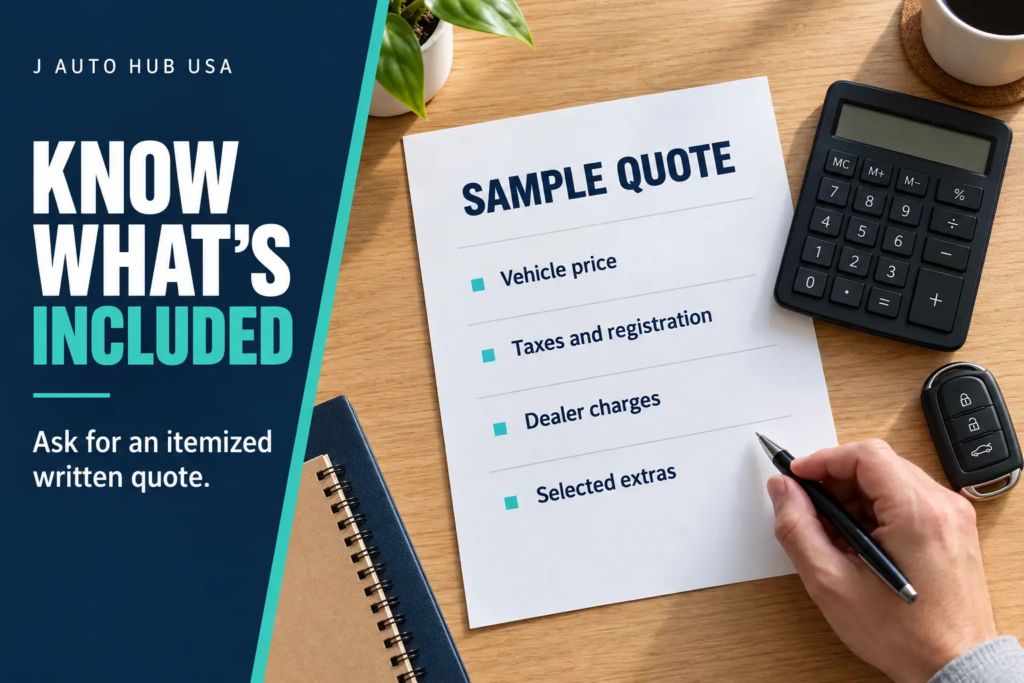
What Should You Ask for in a Written Quote?
Before committing, request a breakdown showing:
- The specific vehicle and agreed selling price.
- Every dealer charge.
- Optional products and their individual prices.
- The tax rate, taxable amount and applicable credits.
- Title, registration and processing charges.
- Amounts payable separately and who handles the paperwork.
- Any trade-in allowance, loan payoff and down payment.
- For financing: amount financed, APR, term, payment schedule and total payments.
Compare quotes using the same assumptions. One quote can appear cheaper simply because it leaves taxes or registration costs out.
Frequently Asked Questions
Is 4.225% the full tax rate I will pay?
No. It is Missouri’s state vehicle sales-tax rate. Applicable local sales tax must also be considered.
Does “no dealer fee” mean no additional costs?
No. Even when a dealership does not charge an administrative fee, applicable taxes, title and registration costs remain separate considerations. Confirm exactly what the advertised price includes.
Can taxes and fees be included in financing?
They may form part of the amount borrowed, depending on the transaction and approved financing arrangement. Ask what is included and review the loan disclosures rather than assuming the entire purchase budget is financed.
How can I get a useful estimate before visiting?
Choose a vehicle, provide the information needed to calculate the applicable charges, and request an itemized quote. Ask the dealership to identify any estimated figures and costs payable separately.
Find a Vehicle and Clarify the Numbers
Start by browsing J Auto Hub USA’s used-vehicle inventory. When a vehicle interests you, contact the Springfield team to confirm availability and ask for a breakdown of the applicable purchase charges.
Knowing the vehicle price, additional costs and payment responsibilities gives you a clearer basis for your next decision.